
Reviewed by Mihailo Miljanic, M.D., MBA | Updated August 19, 2026
Most residency personal statement examples online show you a finished essay and let you assume it worked. They do not show you why a program director kept reading past the first paragraph, or why a different reader stopped after two lines. That is the actual skill worth building, not exposure to more sample residency personal statements, but a way to read one and see the decisions inside it.
A residency personal statement that works does two things early: it commits to something specific enough to be wrong about, and it gives the reader evidence that the writer already thinks like a resident in that specialty. A statement that does not work spends its opening establishing tone (something like “I have always wanted to help people”) instead of making a claim. Everything after that point is either proof or padding, and readers can tell the difference fast.
Below are eight personal statements from ExceptionalGrad’s files, kept out of a larger set specifically because each uses a different approach rather than the same structure with different vocabulary swapped in. If what you actually need is how to write a residency personal statement of your own, treat these as a record of decisions, not a template: read the essay first, then the analysis underneath it, which names the specific move that carries the piece. Before that, it helps to know what a program director is actually reading for, since that is the standard each example gets measured against, not workshop taste.
What Programs Are Actually Reading For
How long a residency personal statement should be
The AAMC states plainly on its ERAS guidance page that the personal statement “is limited to 28,000 characters, which include letters, numbers, spaces, and punctuation marks,” as of August 2026. That ceiling is not a target, and it is the wrong answer to the residency personal statement length question. It works out to roughly four to five thousand words, far more room than any strong statement needs, and treating it as a goal is how statements sprawl.
MyERAS gives you a way to check yourself against something more useful than the character count: it lets you preview your statement “just as the programs will view it, including the number of pages,” before you submit it. A 2022 guide in the Journal of Graduate Medical Education, written for applicants going through this same process, is direct about where that preview should land: the authors “strongly recommend the final statement not exceed 1 single-spaced page,” specifically to keep the reader’s cognitive load low. One page, single-spaced, is the practical ceiling. The 28,000-character limit is just the outer wall you should never get near.
The same ERAS system also lets you write more than one statement and assign a different one to different programs or specialties, which matters if you are applying to more than one field. Each program still only sees one eras personal statement from you, so the tailoring has to happen before submission, not after.
What the opening has to do
A program director reads a large stack of these every season, often deciding within the first few sentences whether a statement earns a full read. The opening’s job is to commit to something specific enough to be wrong about, not to set a tone. None of the eight examples below opens with a general claim about wanting to help people. They open with a declared trait tested against a real event, an unfinished classroom scene with dialogue already running, an instructor’s cue mid-pose, a headline read on a bus, a lesson from a father’s garage, a monitor alarm and a falling number, an honest admission of dread, a one-line declaration of where the writer comes from. Each opening asks a question that the rest of the essay is now obligated to answer.
Telling a story versus making an argument
An essay is not required to be purely one or the other. Most of the strongest ones end up being both, but they arrive at the argument through the story rather than placing the two side by side. A story that stops at “this happened to me and it mattered” is not yet a personal statement. It is the raw material for one.
The turn from story to argument happens when the writer makes explicit what the story proves. The eight examples ahead do this in different places: one states the claim as a thesis before the story runs, so every scene after it reads as evidence. Another waits until the final lines to name what a years-long habit was actually building toward. There is no required order for the turn, but it has to happen somewhere on the page, in the writer’s own words, not left for the reader to infer.
Connecting your life to the specialty
Specialty fit fails when it is stated rather than demonstrated: “I know internal medicine is right for me because I like solving problems” asserts a connection without showing the mechanism. It works when a specific value or skill from the writer’s actual life is tied to something the specialty concretely rewards, in a way a reader could ask a follow-up question about.
That connection does not require a lifelong-passion narrative. Several of the examples below build specialty fit almost entirely out of experience gained during medical school itself, a rotation, an elective, a research project, rather than a story that starts in childhood. Both approaches can work. What fails is fit asserted without a mechanism attached to it.
Where these essays fail
The JGME guide cited above surveyed the mistakes that show up most in early drafts: trouble starting the writing process at all, difficulty organizing a coherent narrative, “losing the personal in the statement,” failing to display a unique or notable attribute, and grammatical errors that “distract readers, highlight inattention to detail.” The authors are also specific about the essays that technically work but still fail: bland statements, which they call “a missed opportunity.”
The AAMC adds a narrower warning directly on its guidance page, telling applicants not to “copy any information from these sites and use it in your personal statements without giving credit to the author,” and naming that behavior as plagiarism. The eight examples below are for studying decisions, not sentences.
One failure mode is common enough to name on its own: a statement that restates the same virtue three different ways instead of proving it once, well. It reads as padding even when every sentence is technically true.
| What programs weigh | Who reports using it | Mean importance (1 to 5) |
|---|---|---|
| USMLE Step 1 pass/fail result (interview selection) | 90% of program directors | 4.5 |
| MSPE / Dean's Letter (interview selection) | 85% of program directors | 4.1 |
| Specialty-specific letters of recommendation (interview selection) | 84% of program directors | 4.2 |
| Interpersonal skills (ranking, post-interview) | 89% of program directors | 4.8 |
| Interactions during the interview (ranking, post-interview) | 87% of program directors | 4.8 |
Source: NRMP, Charting Outcomes: Program Director Survey Results, Main Residency Match 2024, published August 2024.
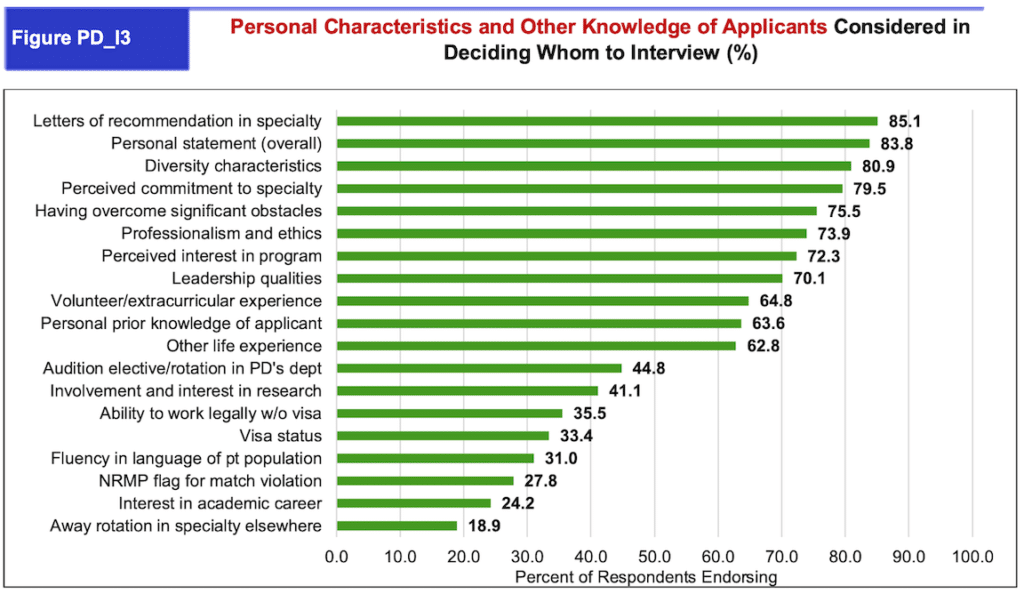
The personal statement itself does not appear by name among the top-cited factors above. Read that honestly: the essay alone will not get you an interview. But the highest-weighted ranking factors, interpersonal skills and interactions during the interview, both live inside the room your statement gets you into, and nearly every question you are asked there will start from something you chose to write.

Eight Residency Personal Statement Examples, With Analysis
These eight residency personal statement examples come from a larger set ExceptionalGrad’s advisors reviewed. Most of that larger set used the same opening move: a scene from childhood establishing when the interest in medicine began. Only one of the eight below still opens that way, kept specifically because it is the version where the childhood detail supports an argument rather than just marking a start date. The essays are reproduced exactly as written, unedited. What follows each one is analysis, not praise, pointing at the specific lines doing the work.
The Character Trait Declared As A Thesis: Internal Medicine
I’m a good listener. As a shy child, I felt more comfortable letting others do the talking. My role as a wild Irishman in a school play helped me break out of my shell. But the habit remained. I know my patients appreciate it. Rotating through the trauma service, I held the hand of a young man who cut open his leg jumping over a fence. He would be completely fine, but he was panicking as a resident closed his wound with sutures. I did what I do best; I listened. He revealed to me that during the ambulance ride, his adrenaline still flowing from what he suspected was a fatal wound (it was not), he proposed to his girlfriend and she accepted. The next day, he thanked me for being there for him. Even though he was afraid of needles, he didn’t hesitate to allow me to draw his labs after I told him I was a novice at phlebotomy. I still feel honored to have earned his trust, and all I had to do was stay silent and let him express himself. I also love to ask questions. I’ve been doing it since I learned to talk; my parents couldn’t take me for a drive without facing fifty questions about how cars were made. In my former business career in strategy consulting, a partner at the firm called it my “superpower.” This skill has served useful to me in clinical medicine. I enjoy playing detective and trying to figure out what is ailing my patients. On my internal medicine rotation, a resident asked me to conduct a depression screen for an elderly woman who seemed “off.” Sensing there was more to the story, I deviated from the script and asked her if she felt safe at home. She confided in me that she did not, that her husband had angrily slammed a door into her, and that he had beaten her in the past. Sometimes it only takes one question to make a big difference in someone’s life, to provide them an outlet for their suffering, and to make available to them the resources that they need. I dream about global health. It has been a major passion of mine since I started a nonprofit, Glasses for Guatemala, in 2012. Recycled eyeglasses are readily available in the U.S. and are very impactful to a person who has never had the opportunity to see with clear vision. When I visit Guatemala and engage my ability to speak Spanish to distribute eyeglasses to those in need, I feel an inner fulfillment that I have not experienced in any other facet of my life. I believe that in general, we undervalue the lives of other people in our world by remaining focused on what is right in front of our eyes: our routine, family, or job. I am determined to inspire others to think about the rest of the world. Living a life of service to others broadens the scope of my purpose in life and allows me to expand to become a welcome part of many other lives. One last thing you should know about me is that I was raised to believe that those with the capacity to make a difference in the lives of others have a responsibility to do so. I changed careers because my personal experiences with ulcerative colitis helped me realize that good health is invaluable. During medical school, I learned that there is too much suffering in our world. I also learned that I could do something about it. I look forward to joining the field of internal medicine, where I can protect my patients from hopelessness and misery, and provide them with care and love. I aim to pair my clinical skills and my business background to become a health care innovator and a global health warrior. Listening to my patients will always come first.
Why this works: The first three words are the entire thesis, stated before a single scene has happened, and every paragraph after it exists to test that claim. The trauma-bay story does not just show the writer being kind; it shows the specific behavior (staying silent, letting a frightened patient talk) that the opening line predicted. The essay then proves a second trait, curiosity, the same way: a quoted line from a real person (“a partner at the firm called it my superpower”) instead of the writer’s own adjective, followed by a concrete outcome (identifying domestic abuse from one deviation-from-script question) rather than a claim about caring. This is the simplest structure in the set, state the trait, prove the trait, state the next trait, prove it, and it works because every proof is a specific clinical moment, never a general virtue. Copied badly, this structure turns into a list of admirable qualities with nothing attached to them, which reads like a resume in paragraph form. It fits an applicant with a genuinely simple, coherent throughline, often a career changer with one clear transferable skill, rather than someone whose story needs a more complicated shape.
The Scene That Shows The Career Change Instead Of Telling It: Family Medicine
“You will complete this activity silently and independently.” Zeke talks; I’m ready for it. “Zeke, the directions were to be silent. This is your first warning.” Pencil-tapping, fake coughing and humming ensue, and I realize I’m not trained to give out warnings for actions I didn’t initially prohibit. This past year I taught high school chemistry in Fort Worth, Texas, through Teach for America. At first, I tried to do everything by the book, knowing there were tried and true methods to teach effectively. Trying to follow a formula to achieve success, I learned the vital lesson that building trusting relationships is necessary for communication. My knowledge of the content wasn’t an issue, but at the beginning of the school year, I was ineffective at reaching many of my students because of my textbook-teacher approach. Only after I had gotten to know my students more personally and developed their trust, was I able to effectively empower and give them tools to take ownership over their learning and therefore their future. I see the same possibility in medicine. In the moments I interact with my patients and develop their trust, I will be able to empower them to gain an understanding of their disease and its treatment and guide them through the process of healing. Towards the end of my first year in the classroom, I was told that “there are few jobs in which you are handed a manual on the first day that explains how to do your job, because all of those jobs are now automated.” I believe that in order to be an effective teacher and physician, one must be able to build relationships and not solely rely on learned skills. Rita Pierson, a veteran teacher, said on a TED talk “kids don’t learn from people they don’t like.” I feel the same way about medicine; patients aren’t going to heal from a physician they don’t trust. The desire to be a role model for my students was my primary motive to teach in a low income community. Having worked in this community for a year, I have witnessed lost opportunity and young people falling short of their goals, stemming in part from the lack of positive role models in their lives. Without leaders in place to procure a healthy community, attaining educational equity is improbable and the chances that my students succeed dwindle. Currently, there are many aspects of my students’ lives that I cannot affect. As a physician I look forward to having a more direct impact on their immediate health and well-being, giving them the chance to achieve their goals. My second motive to become a teacher was due to the inherent role of education in medicine. I wanted to acquire the skills that accompany teaching so that I may use them as a physician. My kids entered the classroom unaccustomed to fully mastering difficult science concepts and therefore scared to attempt to learn them. By developing their trust, I played a role identical to the one doctors I will have with my patients, in which I will teach them about their diseases, taking the fear of disease out of the picture, just as I took the fear of chemistry out of the picture for my students. I will explain complex diseases in understandable terms and build trust with my patients so that they may take ownership over their own health. In 1989, my family immigrated to Milwaukee from the Soviet Union and I was born three years later as the first natural American citizen in my family. Because my family grew up Jewish in the Soviet Union, their chances to study medicine were slim. As a result, there are few doctors in my family. The impact of this became evident when my mom’s first cousin, Lena, was diagnosed with lymphoma during my sophomore year of college. When she was diagnosed, she turned to my uncle, the only person in my family with experience in medicine. She wanted his input because she didn’t trust her doctors, so he met with her oncologists to see what he could do. Despite his efforts and years of training in infectious diseases, he said it was as if the oncologists were speaking another language and he could not convince Lena to listen to her doctors or start her treatment. Because of my experience in teaching and oncology research, I was able to convince her to pursue traditional treatment with chemotherapy rather than the non-evidence based alternatives. I feel fortunate to have the opportunity to become a doctor and bridge my understanding of science with my ability to build relationships. I have come to realize that I have the responsibility to gain the knowledge necessary to care for, comfort and advise my loved ones when they encounter illness and to serve my students and their families as a practicing physician and role model. Reflecting on this past year, I learned that I am able to simplify difficult concepts, communicate them in a meaningful way and build relationships with people in the community I wish to serve; I wish to build these relationships in the clinic rather than the classroom.
Why this works: The essay opens mid-scene, with dialogue already running, and never announces “I used to be a teacher.” It shows a specific failure (a warning issued for a rule that was never stated) before the writer has explained anything, which is a riskier opening than most applicants attempt and it pays off because the next paragraph immediately turns the scene into an argument: “building trusting relationships is necessary for communication,” a claim the rest of the essay defends. The Rita Pierson quote, “kids don’t learn from people they don’t like,” is doing real structural work, not decoration. The writer maps it onto medicine in the very next sentence (“patients aren’t going to heal from a physician they don’t trust”), which is the explicit turn from story to argument that the framework above describes. The family history with Lena adds a second, higher-stakes strand about the cost of a patient not trusting her doctors, reinforcing the same thesis from a different angle instead of introducing a new one. Copied badly, a dialogue-cold-open reads as gimmicky if the scene never gets connected back to a stated claim. This essay fits an applicant with a substantial pre-med career, not a summer job, that produced one transferable skill the writer can defend under questioning.
The Unrelated Life That Becomes The Argument: OBGYN
26 asanas – 2 sets. 2 pranayama breathing exercises. 90 minutes. I stand in front of an endless mirror as the instructor says, “Focus on you and begin.” My home yoga studio sits in a recently gentrified neighborhood in East Austin. Most days, I am the only black yogi there. I cannot focus on that. I must focus on one point on my black body, while determined to fade the surrounding white bodies into the background. I realized early in my Bikram Yoga practice that the sequence and environment uncomfortably paralleled my experience as the only black woman at my medical school. Like the first time entering the 108-degree, 40% humidity yoga studio, I entered this journey of growth knowing that it would be difficult with nearly no knowledge of what “difficult” would entail. I begin with standing deep-breathing pose – moving and claiming space in the nearly unbearable heat. My mind fails to meditate as I consider the instances that I was presumed to be lazy or disorganized as a student for no other reason that I could ascertain besides the color of my skin. Inhale, exhale. I tear my mind back to the present by the end of the second set. The instructor says, “Raise your arms directly in front of you. Stand on the balls of your feet. Focus.” I balance calmly while looking around to see if I’m holding the pose as beautifully as my white counterparts. Why does my mind often seem to wander here? I return to my breath – my muscles, tight and disciplined. “Hold your stomach in. Don’t move your eyes. You can’t even blink. You might fall out of the pose.” A wave of joy comes over me as I feel gratitude for what my body can do when it becomes inextricably linked to my mind – an invaluable skill to harness in training to become a practicing surgeon within the field of OB/GYN. My Bikram yoga practice has taught me several lessons – most importantly, leaning into the feeling of discomfort. I moved away from my hometown in upstate New York to embark on a journey that I knew would catalyze significant growth. I am overwhelmingly grateful for the opportunity to develop into the physician and person I hoped to be from a young age. Since leaving New York to attend Davidson College, I have sprung into new and uncomfortable situations with vigor and eagerness, from virtually developing my own non-profit fellowship experience with a focus on marginalized populations in women’s health to creating a health equity student initiative from the ground up within my first year of medical school. Such experiences have allowed me to push myself and colleagues through challenging situations that call for resilience to failure and an unrelenting desire for improvement. Furthermore, they will serve as powerful narratives that I can share with the women I will take care of in my training and career, as well as with my co-residents. Irrespective of race or background, all women are vulnerable to social injustice – a reality that I will be particularly attuned to. My goal as an equity champion and women’s health physician will be to level the playing field through my patient interactions and mentorship of medical students from marginalized backgrounds. Lastly, yoga has taught me an unwavering discipline that will prove formative to honing my skills as a surgeon and leader in health equity promotion. Bikram yoga beautifully parallels surgery and social transformation in that growth and improvement come from repeating the same sequence several times. Patience and gradual improvement are values I am familiar with, from blazing forward as a member of an inaugural medical school class to thinking critically about how my institution can grapple with and impact the seemingly impossible issue of structural inequities. I will not have to develop such attributes in residency training – I have them today. While I continue to ground myself in the reality that ameliorating health disparities will be a lifetime endeavor, I hold the patience and discipline to see the journey through to the end. I can only hope the feeling will mirror the Bikram’s final pose. I’ve come to do what I need to do and focused on what I can control in the process. Inhale, Exhale. Savasana.
Why this works: Nothing else in this set opens like this one: a clipped, instructor’s-cue rhythm that reads like a clinical protocol before the reader knows it is yoga. That structural choice is the essay’s real risk and its real payoff. An extended metaphor can easily collapse into decoration, but here almost every beat of the practice, the heat, the balance, the discipline, is mapped explicitly onto either a specific experience of isolation (“I am the only black yogi there,” “the only black woman at my medical school”) or a specific professional skill the writer is claiming (the mind-body control “invaluable… to become a practicing surgeon”). The essay earns the metaphor by doing the mapping work in nearly every paragraph rather than once at the end. The closing line, “Inhale, Exhale. Savasana,” deliberately returns to the opening’s cadence, which is a controlled, intentional structural choice, not an accident. Copied badly, a sustained-metaphor essay becomes mood without argument. This approach fits an applicant with an unusual, genuinely sustained personal practice or identity experience that can carry real structural weight, not a hobby paragraph bolted onto a conventional statement.
The Curiosity That Structures The Whole Essay: Radiology
Taking the bus on the first day of my radiology rotation, I checked my email and saw the headline from a news bulletin: “CDC investigating cases of lung illness linked to e-cigarette use.” Since I was going to be rotating specifically with the chest radiology section, the title caught my eye. As the week went on, we saw two cases of vaping-associated lung illness – both of which were diagnosed by corroborating the patient’s clinical history of vaping THC oil with their imaging findings. At the end of the week, two CDC employees even visited the reading room to consult with the attending on other suspected cases that had been referred to them from across the country. The attending taught us about similar cases he had seen in the past and how the number of cases had been growing with the popularity of e-cigarettes. He also outlined how by working with other departments and institutions one might go about keeping a record of these cases to research and demonstrate the harm of e-cigarettes from a public health standpoint. While I had already made up my mind to pursue radiology, this story captures what attracts me to the field. After initially being pulled in different directions, I decided to pursue radiology because it involves the intersection of multiple aspects of medicine that I find particularly compelling: the opportunity to form diagnoses through a combination of imaging and clinical information, the ability to work in quality improvement by regularly communicating with a variety of teams while building collaborative relationships, and the ability to teach in the classroom and clinical setting. I was originally drawn to the field of medicine when I was young because of a “gut” feeling. However, as my reasoning evolved, I realized it was the ability to help patients by working as part of a team to solve specific diagnostic problems that motivated me the most. The radiologist is uniquely placed at the intersection of clinical information and imaging. In order to diagnose vaping-associated lung illness, the radiologist relied on details in the social history provided by the internal medicine team. While I observed this during a radiology elective, I also appreciated and demonstrated this attention to detail and ability to communicate during my clinical clerkships. For example, when I was on my internal medicine rotation, the team had a patient who kept presenting with asthma exacerbations despite her taking medications as prescribed. It was only when I re-interviewed her and realized that she had mold growing out of control in the house that we identified the root cause of her exacerbation. We were able to reach out and link her with a program that offers social assistance to Medicare patients to help solve her mold problem and hopefully prevent future admissions. I am also attracted to the role the radiologist plays in communicating with other specialties and departments. This active communication provides many opportunities to pursue quality improvement within local systems- an interest that I plan to pursue in my career. Specifically, my work pursuing an MPH has demonstrated to me the importance of communication between all stakeholders when working in quality improvement. My capstone project was to implement mental health screenings and institute a referral pipeline for counseling at my medical school. We administered screening tools for depression and anxiety to all medical students and compared the prevalence of each across classes. We noticed an expected spike in both depression and anxiety during the clerkship year and while we will continue to survey each year to see if this trend continues across different classes, we have also held meetings with counselors and students affairs to create a sustainable plan that can ensure students receive easy access to mental health care. Any sustainable solution will require buy-in from counselors, school administration, the clerkship coordinators, and the students themselves. Similarly, if health care is currently faced with the problem of providers and various parties working in different silos, I believe radiologists are well-positioned to use their position at the intersection of imaging and clinical information to build collaborative working relationships and help bridge these gaps. Medical education is another field that relies on building collaborative relationships and one that I plan to pursue both as a resident and attending. Teaching has been a common thread in my life since I was young. I grew up playing classical piano and eventually went to a performing arts high school where nearly half of each day was spent working with teachers and classmates – giving and receiving feedback. Prior to medical school, I taught high school chemistry at my former high school. Many of my students were intimidated by the math involved, and it was by focusing on the use of strategies and repetition that allowed them to make progress. However, before I could convince them to follow a method, it was important to build rapport and communicate that I had once been in their shoes. In fact, chemistry was my least favorite subject in high school – something which they found amusing but also encouraging. I find teaching to be incredibly gratifying, and I know that it is something that will continuously motivate me during my career. It was actually one of my first preclinical professors, a radiologist, who originally introduced my class to the field and became my mentor when I chose to pursue it. In a diagnostic radiology residency program, I want to learn the skills and practices that will prepare me for a career in radiology, while also allowing me to help improve local systems and remain engaged in medical education. Finally, I hope to be a part of a collegial and supportive community. This sense of community is what I believe makes any individual or organization’s goals sustainable -a lesson cemented by my medical school experience. My graduating class has only 50 students, and we will be our school’s first graduating class. I’ve been fortunate to feel both supported and constructively challenged by my classmates as we’ve grown closer over the years, and it would be a privilege to be a part of a similarly supportive community again during residency.
Why this works: Essays built around a current event risk reading like a commentary detached from the writer’s own experience. This one avoids that by grounding the headline in something that happened on the writer’s own rotation two paragraphs later: two real cases of vaping-associated lung illness, diagnosed on the service where the writer was standing. The CDC bulletin is not the point; it is the hook that earns the reader’s attention before the real evidence arrives. The essay then organizes three supporting threads, a diagnostic catch on internal medicine (mold causing recurrent asthma exacerbations), an MPH capstone on mental health screening, and a teaching background, under one explicit thesis stated early: the intersection of imaging, clinical information, and communication. Every thread reports back to that same claim instead of drifting into a separate one. The specific number, “my graduating class has only 50 students,” and the mold-and-asthma detail are the kind of checkable particulars an interviewer can ask a real follow-up question about. Copied badly, a news-hook opening turns into an op-ed with the writer nowhere in it. This approach fits an applicant whose interest in a specialty is genuinely intellectual and diagnostic rather than built around a single relational moment, a useful contrast to the essays built around one patient encounter.
The Origin Story That Earns Its Place: Orthopedics
My earliest memories consist largely of helping my father in our garage while he worked on his cars. From changing the oil to grinding down exhaust pipes so that they would fit into his latest project, we did everything together. He taught me to measure twice and cut once, that you always needed the correct tool for the job, and that knowing why you are doing something is as important as knowing how to do it. And although I grew up in the garage, I also spent a significant time surrounded by medicine. At 13, I witnessed my friend break his arm on the baseball field and during my playing career, I had my own injuries and rehabilitation. In a high school magnet program in medicine, I shadowed various specialties in the hospital setting. My first case while shadowing was a total hip arthroplasty, and I was immediately drawn to orthopaedics. The same principles that my father taught me are prevalent in orthopaedics – surgeons can diagnose a patient’s problem and use their hands to treat it. And even more than treating a problem, regardless of who the patient is, we can help them regain mobility and live life to its fullest. In the magnet program at my high school, I was mentored by a medical student – which supplemented the mentorship of my father – this mentorship was vital to my own success. Upon acceptance to medical school, I felt determined to give back to aspiring pre-med students. As co-director of the Health Career Collaborative program at my medical school, we mentored a group of seventeen underrepresented high school students from low socioeconomic backgrounds. It was gratifying to watch the students blossom from timid sophomores to confident seniors graduating at the top of their class with plans to pursue higher education and careers in medicine. Reflecting on the impact I was able to make on my mentees, I found mentorship incredibly rewarding and will continue to support aspiring medical professionals for the rest of my career. I am convinced about the power of effective mentorship and plan to take every opportunity to work alongside and mentor learners in a residency program. Continuing my role as a mentor and leader, during my third year of medical school I pursued a dual-MD/MBA where I had the opportunity to lead a team and combine my love of medicine with my strategic and growth mindset. During my capstone project, I put into practice the teachings of both degree programs and designed a business proposal to bring a tactical athlete program to the community. Tactical athletes (e.g. military, police officers, and fire fighters) must always be operational under the most challenging of circumstances. As such, they incur a vast number of musculoskeletal injuries, many of which are preventable. Working across a multi-disciplinary team, we designed a program that could save the city hundreds of thousands of dollars and made a successful proposal for plan integration. This experience of combining business and medicine while making an impact in my community is something I hope to continue throughout my residency. Every time I scrub into cases, I am reminded of my father’s garage and the lessons he instilled in me: the importance of technical skills coupled with preparedness and intellectual curiosity. I am eager to utilize my work ethic and team orientation that I learned on the baseball field to diagnose and treat patients as they embark on their journey towards mobility. Through my desire to be a mentor and my MBA mindset and business acumen, I am confident I will be an actively contributing and effective orthopaedic surgery resident. I am constantly reminded to give back what was given to me, and I am excited for the opportunity to practice my passion as an asset in your program. Thank you for taking the time to review this statement and my application.
Why this works: The childhood-garage opening is the single most common structure in the larger set this essay was chosen from, and it is also the structure that fails most often, because most childhood scenes describe a memory without arguing anything from it. This one survives because every lesson from the garage gets a literal, checkable payoff later: “measure twice and cut once” and “the correct tool for the job” become, two paragraphs later, an explicit claim that “the same principles that my father taught me are prevalent in orthopaedics.” The childhood material is not decoration establishing when the interest began; it is the premise of an argument that the rest of the essay defends. The mentorship of seventeen underrepresented high school students and the MD/MBA tactical-athlete capstone both extend the same thesis, technical skill paired with intentional preparation, rather than introducing new, competing themes. Copied badly, this is the essay that produces the most generic drafts in the genre: a garage, a grandparent, a childhood injury, followed by an unearned leap straight to wanting to be a doctor, with no mechanism connecting the memory to the specialty. It fits only an applicant who can trace a literal line from a specific childhood detail to a specific professional skill or value, not one who wants a childhood scene because it feels appropriately personal.
The Clinical Scene That Opens Before Any Explanation: Anesthesia
The pitch of the anesthesia machine steadily became lower as the patient’s oxygen saturation started decreasing. A loud beeping alarm became apparent as his blood pressure began to fall. Just a few minutes ago, the patient was sitting up and talking, and the next, the situation changed. Through the intensity and urgency that had developed in the OR, the anesthesiologist at the head of the bed maintained a calm demeanor. He had one hand on the bag and the other on the face mask, applying pressure and oxygen for the patient while running through the “ABC’s” of critical care. As the patient’s pulse began to disappear, compressions were started, and the anesthesiologist began to delegate tasks like a conductor in an orchestra. This experience is one of the many reasons that motivate me to pursue a career in anesthesiology. Watching as the anesthesiologist was able to manipulate and tweak the ventilation machines to minute detail in order to keep the patient stable during surgery was awe inspiring, especially with having to understand the physiology that is in a way unique to each patient. This is further exacerbated by the plethora of pharmacotherapies that are utilized by the anesthesiologist depending on context and situation. This mastery of physiology and pharmacology is something that I aim to strive for. Anesthesia piqued my interest when I was first exposed to the specialty during the 2nd year of medical school. In a way, this is due to the similar characteristics and traits shared between my experiences with teaching and anesthesia. For example, the importance of first impressions is invaluable for both professions, the ability to organize and delegate tasks, and adaptability to changing circumstances in real-time. Before enrolling in medical school, I was a science teacher for an underserved high school in Las Vegas. During clinical rotations, I was determined to utilize the skills that I had learned as a teacher to create a foundation and help make me a better clinician. One of which is the importance of first impressions. The teacher’s role on the first day of class is to develop a trusting and respectful relationship with the students to achieve student success. This is through individualized planning and student-centered goals. Anesthesiology offers me the opportunity to use these same skills to develop a trusting relationship with patients in a short amount of time. Furthermore, as no two students are the same, no two patients are the same. Anesthesia allows me the ability to factor in each patient’s uniqueness such as their anatomy and physiology to provide patient-centered care and comfort. Whether that’s through providing an epidural during delivery or a femoral nerve block for knee surgery. During college I have been interested research and had the opportunity to pursue an MPH while in medical school. Through this MPH I was able to further improve my knowledge of conducting literature review and asking research questions as well as understanding epidemiology and population health. My project during my MPH focused on conducting a quantitative analysis for the use of Ketamine to treat suicidal ideation. In this project I was able to conduct interviews with important stakeholders as well as analyze clinical data to answer a research question. This is one of my goals as an anesthesiologist, to utilize the techniques and skills that I have learned during my MPH to further answer research questions. Before starting clinical rotations, I had heard of the term “patient-centered” care, however did not know exactly quite what that meant. Over the course of the 4 th year I would embrace the term as the foundation to how I would help to provide care now and in the future. This ranged from updating families about the patient’s care to bringing a warm blanket. Furthermore, incorporating multidisciplinary teams involved in the patient’s care such as through interfacing with the patient’s nursing team and the radiology and pathology team. I am interested in continuing to utilize patient-centered care as an anesthesiologist as a holistic and multidisciplinary approach both in the OR and in the consulting room before.
Why this works: The essay opens inside a crisis, the machine’s pitch dropping, the alarm sounding, before naming a single person or explaining what is happening, which is a deliberately riskier choice than opening with context first. It pays off because the scene isolates one precise, admirable trait rather than general drama: “the anesthesiologist began to delegate tasks like a conductor in an orchestra.” That single image is the entire thesis of the essay, and the teaching-to-anesthesia comparison that follows exists only to claim that exact trait for the writer. The parallel is made explicit, not implied, in a single sentence that pivots from one claim to the other: “as no two students are the same, no two patients are the same,” the same structural move used elsewhere in this set to turn a scene into an argument. The MPH research on ketamine for suicidal ideation adds a credibility layer without derailing the central claim. Copied badly, a dramatic cold open with no attached argument is just a scene from television, memorable but proving nothing about the writer. This approach fits an applicant with one vivid, specific clinical or shadowing memory they can dissect for the exact skill it demonstrates, backed by corroborating evidence elsewhere in the file.
The Honest Change Of Mind: Psychiatry
I was not looking forward to my rotation in the psychiatric ward and regarded this as only as a necessary obstacle that I had to surmount in order to qualify as a doctor. However I became fascinated with the patients, their conditions and treatments. I soon realized that every patient was person who had goals and hopes a person who had a family and friends who loved them and anxiously awaited them to emerge from the mental ‘maze’ in which they found themselves. My apprehension was replaced with empathy, sympathy and a longing to be of some help. Following my internship, I worked in the medicine department of a missionary hospital. There was no psychiatric department and our department was responsible for dealing with psychiatric patients. The cases we handled were not extreme, being mainly fairly mild depressive conditions, but I was involved in counseling some of these patients and found enormous satisfaction in doing so. I also identified psychiatric illness in, apparently routine, ER patients on several occasions by careful observation. When counseling, I learned that understanding and responding to non-verbal signals is a very important skill in dealing with distressed patients and is one that I naturally possess and hope to develop further. I have always sought to care about my patients as well as caring for them and I believe that this is especially important in psychiatry. Ultimately, I hope to be involved in research and teaching. With this in mind, I joined an MD program in Pharmacology and I had started a thesis project in psychiatry when I obtained permission to enter the US. The study related to the efficacy and safety of Tianeptine compared to Sertraline for treatment of major depressive disorder. My work also involved the study of phsycopharmacology and I began to think back to my internship work with psychiatric patients and my interest in psychiatry was re-fired. Once in the US, I considered my choices carefully and decided to pursue psychiatry rather than pharmacology. One great difference between psychiatry in India and the US is that it is rare to see dementia patients in India. In my culture, the family generally takes full responsibility for the care of their elderly, dementia sufferers are indulged and cherished in a familiar environment and medical intervention is sought only in extreme cases. In the US the situation is very different and the effects of aging constitute a growing challenge as the elderly grow in numbers and as a proportion of the population. Their problems being compounded by the fact that they often find themselves in unfamiliar surroundings once they lose their ability to care for themselves. Psychiatry has a great and growing responsibility in this area of work and is one that greatly interests me. I realize that understanding the cultural background of a psychiatric patient can hardly be overstated. I have worked and studied with people of many cultural and social backgrounds and am eager to extend these experiences and familiarize myself with cultures that are new to me. I am aware that there will be many well qualified applicants for residencies in this fascinating specialty. However I believe that I am an exceptional candidate. I am diligent, intelligent with a capacity for hard work; I have substantial experience of providing medical care, including the counseling and identification of psychiatric patients, in a hospital setting; I have carefully prepared myself for the program, having been an ‘observer’ in US hospitals. However my main recommendation is a passion for psychiatry that I look forward to demonstrating in the program.
Why this works: “I was not looking forward to my rotation in the psychiatric ward” is close to the opposite of what applicants are usually coached to write, and it works precisely because it is honest and immediately earned. The reversal that follows is not a change of feeling on its own; it rests on specific clinical responsibility, counseling patients at a missionary hospital with no psychiatric department, correctly identifying psychiatric illness in patients presenting for something else, and an actual thesis comparing two named drugs, tianeptine and sertraline, for major depressive disorder. Those specifics are what separate an earned reversal from a convenient one. The essay also does double duty explaining an unconventional path (a pharmacology program, a move from India to the US) while making the motivation case, and the observation about dementia care differing by culture adds a genuine, checkable perspective rather than a generic diversity claim. Copied badly, a bare admission that the writer’s mind changed is one of the easiest structures to fake, and without a specific evidence trail behind it, it reads as a performed reversal rather than an earned one. This approach fits an applicant whose real interest built slowly rather than someone who needs to perform a lifelong calling, and it is particularly useful for a file that otherwise looks unconventional, since the same essay can carry both jobs.
The Voice That Doesn't Sound Like Anyone Else's: General Surgery
I come from a long line of military and manual labor. Spending the majority of my formative years in rural Parker County, Texas, I had a seemingly equal chance of becoming a roughneck on an oil rig than I did pursuing the path to medical school. If I had not had an intelligent and influential older brother to serve as a role model for academic success; I might have been pulled even further toward manual labor like my peers at the time. Being a first generation academic in my family, it seems as though I was building the bridge as I was walking across it. However, I have been told by those closest to me that being a blue-collar man on a white-collar pathway has given me a unique perspective. This perspective is likely best described as one of mental toughness and has certainly kept me even keeled through the ups and downs of life and medical training. As I went through clerkships, I quickly learned that surgery was gritty. The residents were on the grind all day and often into the night. This was the closest I had seen to the roughneck, manual labor mentality that I was familiar with. The surgery residents were putting in the hours for their patients when they could have gone home. They were unafraid to take ownership of the outcome of case, no matter what that outcome might be. The pecking order and overall mentality of surgery was the first time in medical school that I felt like I truly fit in and was disappointed when it ended. I had at that point confirmed I wanted to be a surgeon, but I needed to figure out what type of surgeon I was going to be. I mulled over a few different ideas, but I was immensely drawn to vascular surgery. I really liked the skillset that was required to successfully perform a vascular procedure. It requires a great deal of finesse and creativity at times. No two patients’ needs are exact, and the multitude of available treatment modalities allows the vascular surgeon to tailor the best option to the patient. This is an extremely attractive aspect of the field for me. I also enjoy the patient population. Vascular patients are often particularly vulnerable and sometimes have an added layer of personal or social difficulties. I have received feedback from residents and mentors that I connect very well with these patients. I think this might be due to background and upbringing. My family, for better or worse, is less removed from many of the unfortunate attitudes and circumstances that vascular patients contend with. I think this has allowed me to relate and understand their difficulties on a very basic and human level. The ability to build long-term relationships with these patients is another major draw for vascular surgery in my eyes. As for long-term goals I want to be an effective, efficient, and masterful vascular surgeon in my future career. Although I definitely have strong research interest and enjoy teaching, my primary goal is to be the best vascular surgeon that I can be. In training I hope to take care of an extraordinarily high volume of patients and achieve proficiency in both open and endovascular techniques. I am looking for a program that will aid me in this goal and provide the best training possible.
Why this works: “I come from a long line of military and manual labor” declares social background in the first sentence and never softens it into generic professional register: roughneck, oil rig, grind, pecking order are the writer’s actual diction, not a polished translation of it. That distinct voice is the essay’s argument, not decoration around one. The pivot from general surgery’s culture (“the pecking order… was the first time in medical school that I felt like I truly fit in”) to a specific subspecialty, vascular surgery, is built on a craft argument, finesse, no two patients’ needs are exact, rather than a restatement of the fit-in feeling. The line about family background (“less removed from many of the unfortunate attitudes and circumstances that vascular patients contend with”) does real work connecting upbringing to patient rapport instead of leaving the connection implied. Copied badly, a distinct voice borrowed without a genuinely different background behind it reads as performed, and an admissions reader who interviews applicants regularly, which is exactly how programs use these essays, tends to catch a performed voice quickly once the conversation starts. This approach fits an applicant whose actual register is genuinely different from the median file and who is willing to let it show rather than smooth it into interchangeable professionalism.

What The Eight Have In Common
None of the eight opens by declaring a lifelong passion for medicine. Each opens inside a specific, ownable moment: a trait tested against a real patient, a classroom mid-lesson, an instructor’s cue, a headline on a bus, a father’s rule about tools, a monitor alarm, an honest admission of dread, a sentence about where the writer comes from. That is not a stylistic preference. A specific opening is the only kind that can be tested, and a general one cannot be wrong about anything, which makes it forgettable by design.
Each essay pairs its scene with an explicit argument about what the scene proves, stated in the writer’s own words somewhere on the page, not left for the reader to infer. The garage lessons become a claim about orthopaedic principle. The yoga practice becomes a claim about mind-body control under a surgeon’s discipline. The classroom scene becomes a claim about trust as the mechanism of healing. Take the argument out of any of these essays and what remains is a well-written story that does not do the job a personal statement has to do.
Every piece of evidence offered is specific enough that an interviewer could ask a genuine follow-up question and the writer would have more to say, not less: the garage tools, the East Austin yoga studio, the vaping cases seen that specific week, the tactical-athlete capstone, the tianeptine-versus-sertraline thesis, Parker County, Texas. None of it is a claim about character floating free of a checkable detail.
Specialty fit is argued through a mechanism in every case, never asserted on its own. And only one of the eight opens in childhood, which is worth sitting with, since it was also the most common opening in the larger set these were chosen from. It is the instinct most applicants reach for first, and it is also the instinct most likely to produce a statement that describes a life without arguing anything from it.
Seeing your own draft this way is the hard part. You already know what you meant when you wrote it, which is exactly what makes it difficult to read what you actually put on the page. That gap is why a medical school personal statement or a residency one alike tends to improve most on its fourth or fifth pass, reviewed by someone who was not there for the memory and can only go by what the sentences actually say.
Frequently Asked Questions
How long should a residency personal statement be?
ERAS caps the personal statement at 28,000 characters, but that ceiling is not a target. A 2022 *Journal of Graduate Medical Education* guide recommends the final draft not exceed one single-spaced page, and MyERAS lets you preview exactly how many pages your statement will render to before you submit it.
What should be in an ERAS personal statement?
Two things: why you chose this specialty, and what evidence shows you would be good at it. The strongest statements ground both in one or two specific, checkable experiences rather than a list of admirable qualities. If a claim would not survive a follow-up question in an interview, it does not belong in the draft.
Does an ERAS personal statement have to be one page?
Not by rule. ERAS’s actual limit is 28,000 characters, roughly four to five thousand words, far more room than any strong statement uses. In practice, one page single-spaced is the working standard programs are used to reading, and MyERAS shows you the page count your statement will render to before you submit.
What makes a good personal statement for residency?
One that commits to something specific enough to be wrong about in its opening, then proves it with one or two experiences an interviewer could ask about directly. It connects a real skill or value from your life to what the specialty actually requires, rather than stating interest and moving on.
Can I use ChatGPT for a residency personal statement?
For brainstorming, proofreading, or editing, yes. AAMC’s own ERAS guidance states the final submission “should represent your own work,” and interviewers are trained to probe the specific details a statement claims. A statement that used AI to write the substance usually cannot survive that conversation.
Get Your Statement Ready This Application Cycle
Programs begin receiving applications on September 2, 2026, and can start reviewing them on September 23. The strongest move before then is putting a finished draft in front of someone who reads these for a living, not a workshop. ExceptionalGrad’s advisors include an interviewer for medical residency admissions, and our medicine personal essay editing pairs you with an advisor who edits your statement without ever writing it for you. Take the next step and get a free consultation this application cycle.